 ClockPrices.Com
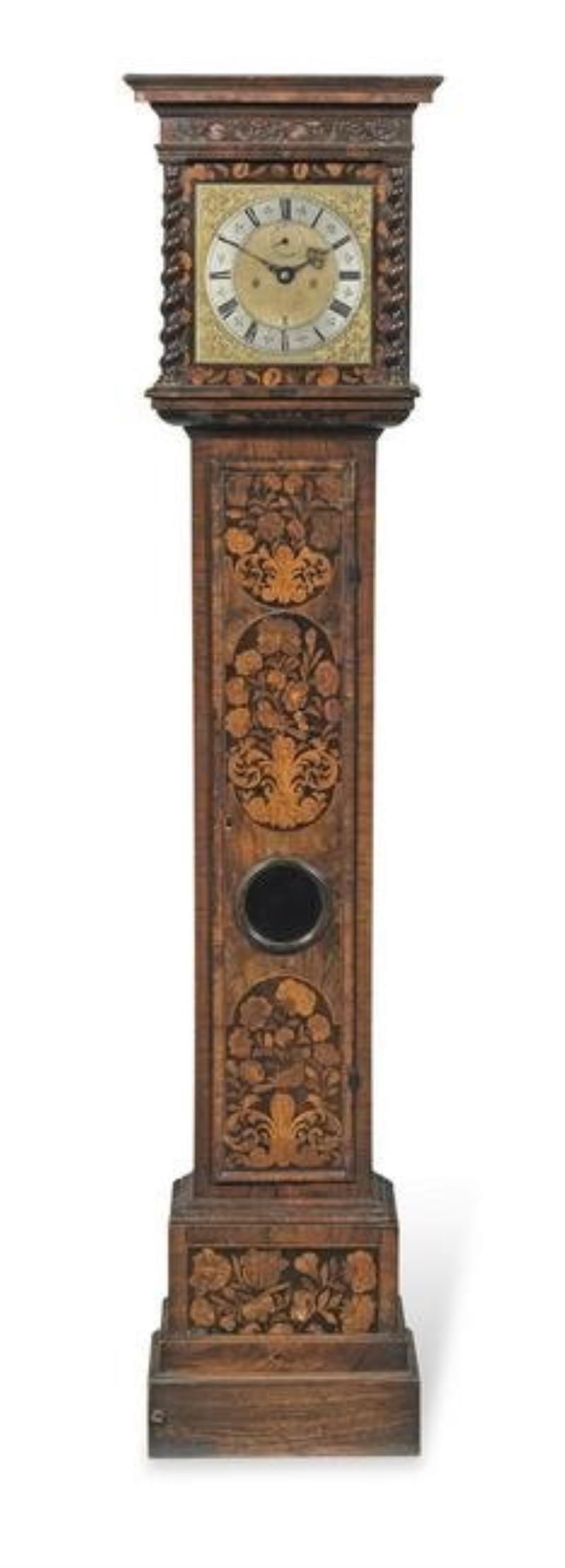
A late 17th century marquetry longcase clock with ten
- Estimate:
- Auctioneer:
- Sold Price:
- Sold Date:
A late 17th century marquetry longcase clock with ten inch dial and bolt-and-shutter maintaining power
William Clement, Londini fecit
The flat top over a blind fret cut cornice over spirally twisted columns, convex throat moulding and 42 inch long door inlaid with three shaped panels of bird and flower inlay framing the circular lenticle, on a matching base (now partly built up). With spoon lock to the throat.
The 10-inch square brass dial with winged cherubs head spandrels and foliate engraving framing the silvered Roman and Arabic chapter ring, finely matted centre with slender subsidiary seconds ring and decorated date aperture. Secured to the movement by four latched dial feet.
The rectangular movement plates united by six knopped and ringed pillars latched to the frontplate, with capped barrels, the going train with bolt-and-shutter maintaining power to the anchor escapement, the strike with outside countwheel, striking on the large bell. The backplate further set with a brass bracket which secures to a conforming bracket on the case backboard via a butterfly nut. Ticking and striking. Together with the door key and a crank winding key.
2.01m (6ft 7ins) high.
Footnotes:
Provenance:
The estate of John Graveson, (1946-2021), son of Professor Ronald H Graveson, CBE (1911-1991). Professor Graveson was one of the most highly respected collectors of Fine English clocks in the 1960s and 70s.
Purchased Sotheby's Important Clocks, English Pottery, Rugs and Carpets, Tapestries and Fine English Furniture, Thursday 30th January 1964, lot 80. 'A late 17th century marquetry longcase clock by Wim. Clement, Londini fecit…'.
A note in the margin gives the purchase price of £360 – in the same sale a walnut longcase by Christopher Gould sold for £140 and a walnut longcase by Joseph Windmills realised £180. A copy of the catalogue is included with this lot. Additional paperwork includes a receipt for a replacement pendulum suspension from Camerer Cuss & Co, 9-3-1964 for £17-6d. Another for various minor jobs from A. & H. Rowley Parkes & Co. 30-9-1965 for £47-10d, and a handwritten letter from Daniel Parkes, detailing work done to the retaining bracket dated 8th October 1965. The clock has remained in the Graveson family for the last 57 years.
This lot is subject to the following lot symbols: TP
TP Lot will be moved to an offsite storage location (Cadogan Tate, Auction House Services, 241 Acton Lane, London NW10 7NP, UK) and will only be available for collection from this location at the date stated in the catalogue. Please note transfer and storage charges will apply to any lots not collected after 14 calendar days from the auction date.
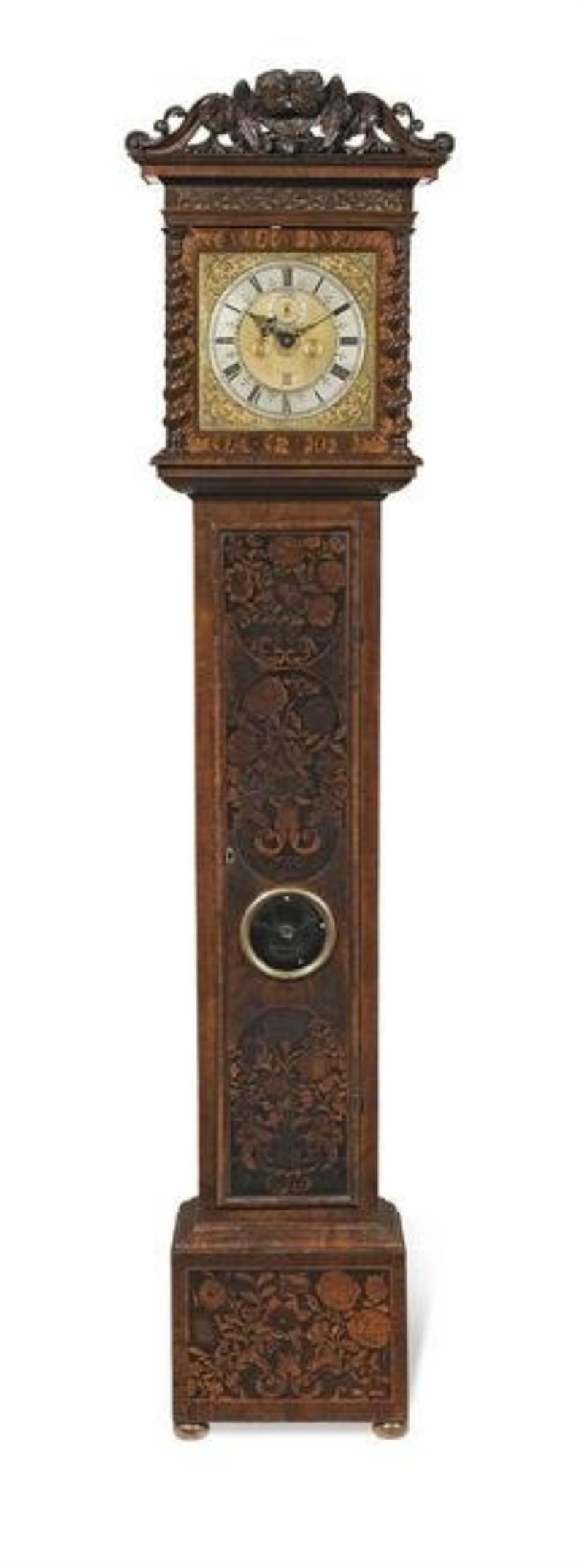
A late 17th century walnut marquetry longcase clock
- Estimate:
- Auctioneer:
- Sold Price:
- Sold Date:
A late 17th century walnut marquetry longcase clock with bolt and shutter maintaining power, previously in the Wetherfield Collection
Christopher Gould
Surmounted by a (later?) carved cresting of two cherubs heads over a pair of wings and scrolls, with twist columns and an inlaid front door, the trunk with three panels of bird and flower inlay on a matching panel base raised on bun feet, the 10.5ins square brass dial with engraved wheatear border framing the large winged cherubs head spandrels, Roman and Arabic chapter ring (with half-quarter marks), finely matted centre with subsidiary seconds, ringed winding squares, chamfered decorated date aperture and engraved foliate boss to the centre, with fine blued steel hands, the movement with five knopped and ringed pillars, bolt and shutter maintaining power to an anchor escapement, with outside countwheel strike on a bell, the backplate with shaped aperture for the pallet arbor 2.1m (6ft 11ins) high.
Footnotes:
Provenance:
The Wetherfield Collection in the early 20th century.
Literature:
Illustrated on the front cover Bruton, E. (1981) The Wetherfield Collection of Clocks a Guide to Dating English Antique Clocks. London: N.A.G. Press Ltd. Illustrated and described page 146, plate 100.
This lot is subject to the following lot symbols: TP
TP Lot will be moved to an offsite storage location (Cadogan Tate, Auction House Services, 241 Acton Lane, London NW10 7NP, UK) and will only be available for collection from this location at the date stated in the catalogue. Please note transfer and storage charges will apply to any lots not collected after 14 calendar days from the auction date.
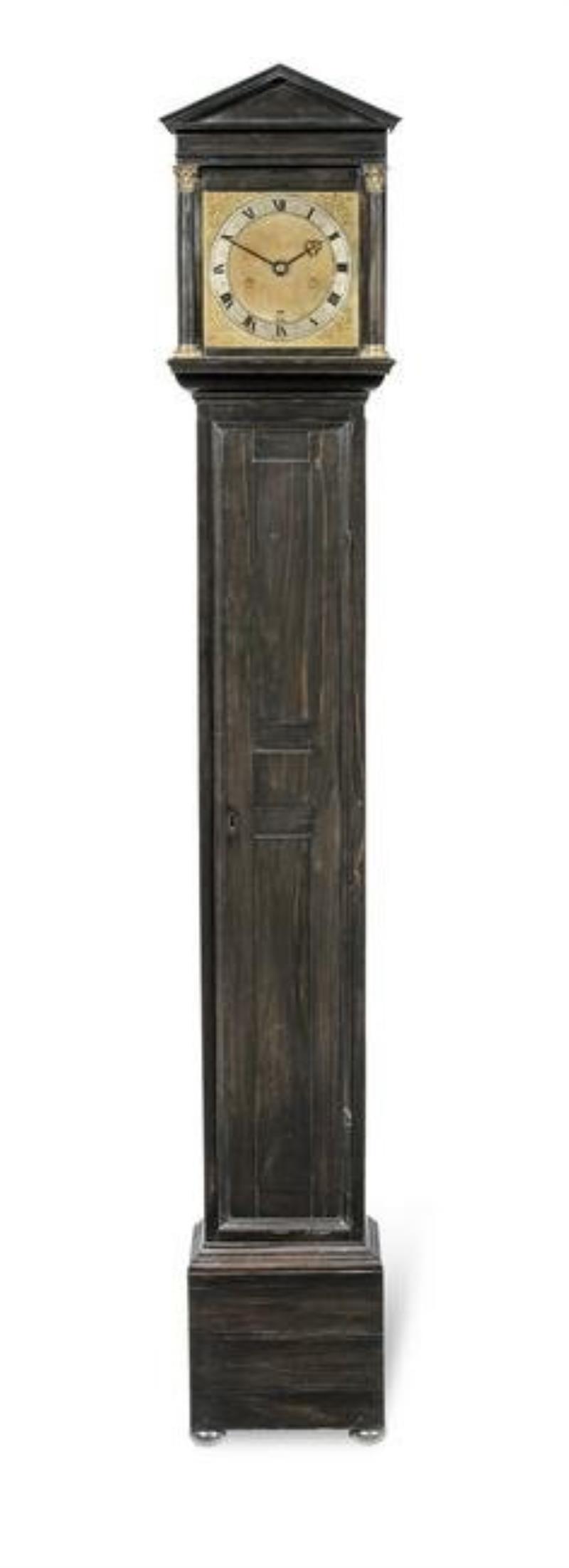
A very fine and rare 17th century longcase clock
- Estimate:
- Auctioneer:
- Sold Price:
- Sold Date:
A very fine and rare 17th century longcase clock movement with verge escapement, now contained in a bespoke architectural ebony case
Edward East, London. The movement circa 1665-70, the case possibly made by Percy Dawson in the 1920s?
The 8.25 inch square brass dial with single line border framing the engraved spandrels depicting split pomegranates, gourds, and grapes around a narrow silvered chapter ring, the minute band with Arabic five-minute markers within the band, short Roman hour markers and a narrow quarter-hour track, the finely matted centre with small date aperture above VI, blued steel hands. Signed along the lower edge 'Edwardus East, Londini' Four latched dial feet to the movement.
The weight driven movement with tall rectangular plates with chamfered corners united by five knopped and ringed pillars (all latched), an L-shaped retaining bracket screwed to the upper right hand corner. The high barrels with slightly rounded front ends, the going train terminating in a verge escapement, with short pendulum and pear-shaped bob; the strike train with small countwheel and vertical hammer both mounted high on the backplate, striking on the horizontal bell above.
Now contained in a 1920s (?) expertly made architectural case, the rising hood with shaped wooden catch to the backboard, triangular pediment supported on turned quarter and three-quarter columns with lacquered brass Corinthian capitals and bases, the 45 inch long trunk door with three raised panels and lock within a moulded edge, the sides with single moulded panel running the length of the sides to a plain base on bun feet. 1.92m (6ft 4ins) high.
Footnotes:
Provenance:
The estate of John Graveson, (1946-2021), son of Professor Ronald H Graveson, CBE (1911-1991). Professor Graveson was one of the most highly respected collectors of Fine English clocks in the 1960s and 70s. Purchased from one of the great post-war clock dealers, Charles Thornton in 1961.
Literature:
Dawson, G.P., Drover, C.B., Parkes, D.W. (1982) Early English Clocks. Woodbridge: ACC, plate 156.
Original paperwork from Thornton relating to the 20th century history of the clock are included with this lot. The first, dated 25th November 1960, reads:
'Nice to hear from you again & do admit to a mistake when I wrote to you. I had the figure of £1250 on my mind, which I had refused to take for the East, as it would have left the country. The price I quoted to you was £1200 & of course I will stand up to this if you are interested. Please don't hold me to this price after the year end for quite frankly I shall be asking much more; for this is an even rarer clock that I think you realize….'
Another dated 16th January 1961 states:
'Thank you very much for your letter & enclosed cheque for the Edward East for which I have pleasure in sending receipt. You have bought yourself a very rare & fine clock. Now you have bought it & the deal is settled I can tell you that some weeks ago the trade in USA offered me £1250 cash for same – this I refused and since then they increased their offer which I also declined. I was determined that I was going to sell it to stay in this country that is why it gives me great pleasure to sell to you at less money. I am not saying that I would have done this thirty five or forty years ago when I was hard up and struggling along but thank goodness it came in to my possession when it did so that I was able to do this. This clock was on show at the South Kensington Science Museum for over six months as the only example of Edward East with bob pendulum & bolt & shutter that was known…'
The receipt dated 16th January 1961 describes the clock as follows:
'To Fine small long case clock by Edward East in ebonised case, eight day movement with strike, bolt & shutter, date aperture, bob pendulum, original hands, movement original and shown & (sic) the South Kensington Science Museum, slight restoration to ebonised case………£1200. '
It is now thought that the case rather than being 'slightly restored' was made to order, probably in the 1920s from the great case maker Percy Dawson. It is a testament to Dawson's skill and sensitivity as a case maker that the clock has been described as completely original by others since then. Dawson later went on to co-author the standard work on early English clocks, and illustrated this movement in 'Early English Clocks', plate 156.
Exhibited
The Science Museum, London 'British Clockmaker's Heritage Exhibition May 23rd to September 14th, 1952, exhibit number 76
'LONG-CASE MOVEMENT by EDWARD EAST, LONDON, C 1665-1670. Eight day. Weight driven with a verge escapement and short bob pendulum. It has Dutch striking mechanism with small locking-plate high up on the backplate, and bolt-and-shutter maintaining power. The dial which is 8 5/8in. square has a narrow chapter ring. The centre is matted and the corners engraved. The plates are shaped at the top. Lent by Chas. Thornton, Esq. ' A copy of the exhibition catalogue is included with this lot.
A comparable longcase clock by East with verge escapement, vertical bell and 8.25 inch fruit-engraved dial was exhibited in these rooms at the exhibition 'Innovation and Collaboration' September 2018, exhibit number 33.
This lot is subject to the following lot symbols: TP
TP Lot will be moved to an offsite storage location (Cadogan Tate, Auction House Services, 241 Acton Lane, London NW10 7NP, UK) and will only be available for collection from this location at the date stated in the catalogue. Please note transfer and storage charges will apply to any lots not collected after 14 calendar days from the auction date.
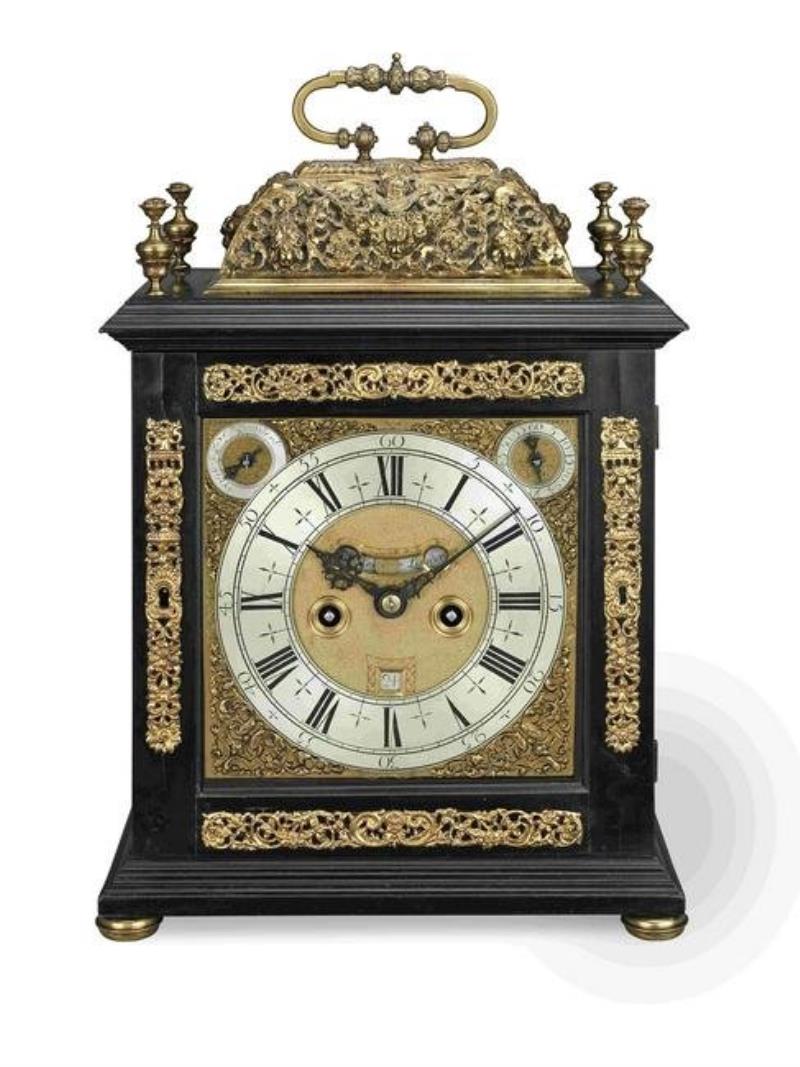
A late 17th century ebony basket top table clock with
- Estimate:
- Auctioneer:
- Sold Price:
- Sold Date:
A late 17th century ebony basket top table clock with twin subsidiaries Signed behind the mock pendulum aperture
William Webster London
Repousse basket top with knopped bud handle over four unusual finials and an intricately moulded cornice, rectangular glazed side panels to a moulded plinth and brass button feet, both doors with applied repousse mounts, the 6.75 inch square brass dial with twin subsidiaries for strike/silent and rise-and-fall regulation in the upper corners, the silvered Roman and Arabic chapter ring with meeting-arrowhead half-quarter marks, finely matted centre with ringed winding squares and decorated mock pendulum (revealing the signature) and date apertures, the twin gut fusee movement with verge escapement with rise and fall pendulum mounted on an engraved curved arm terminating in a rack and pinion, with lenticular bob, the strike train with internal rack sounding on the bell, with pull quarter repeat on three bells and hammers. Running, striking and repeating. Together with a door key (which operates both locks) and a later winding key. 40cms (16ins) high.
This lot is subject to the following lot symbols: *
* VAT on imported items at a preferential rate of 5% on Hammer Price and the prevailing rate on Buyer's Premium.
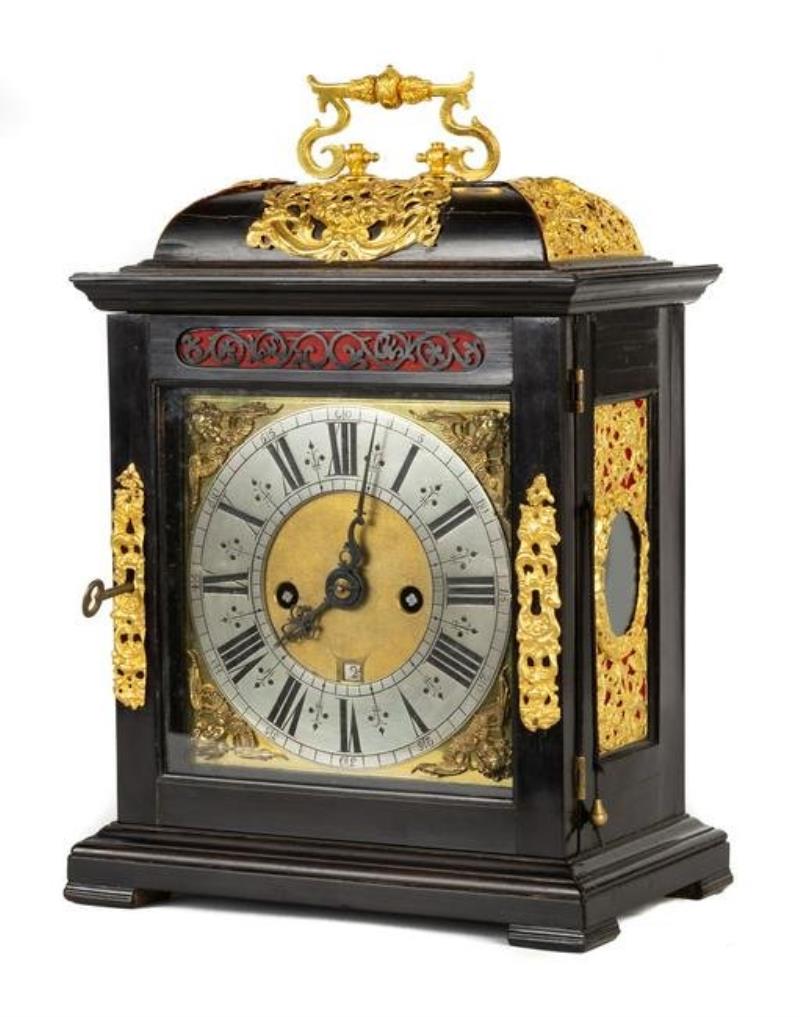
Late 17th, Early Century Adamson, London Bracket Clock
- Estimate:
- Auctioneer:
- Sold Price:
- Sold Date:
Late 17th, Early 18th Century Adamson, London Bracket Clock. Ebonized case with gilt bronze mounts. Brass dial with silvered chapter ring. 8 day time and strike with calendar fusee movement. With a finely engraved and signed back plate. Ht. 14″ W 9″. The Ferd Kirshberger Collection, VA.
A late 17th century ebony basket topped table clock
- Estimate:
- Auctioneer:
- Sold Price:
- Sold Date:
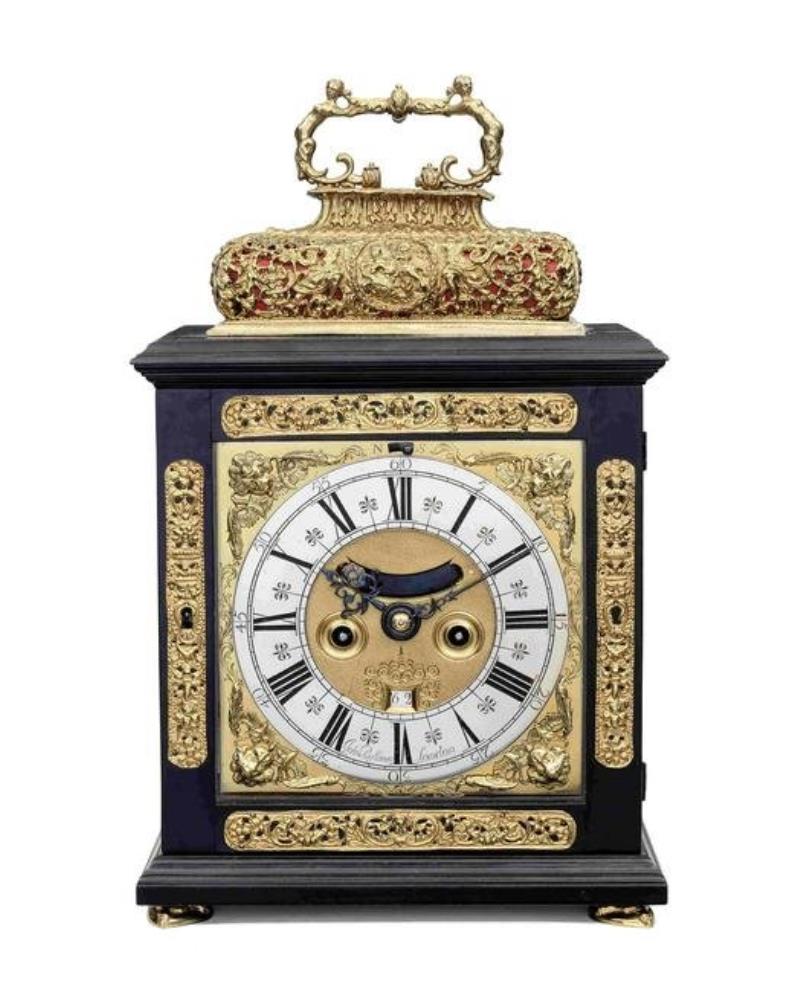
A late 17th century ebony basket topped table clock with pull quarter repeat
John Bushman, London
Surmounted by an elaborate figural handle over a pierced basket top centred by a medallion of George and the Dragon flanked by supporters, the sides with similar portrait medallions, over a moulded cornice and repousse framed side windows, to a moulded base and claw feet, the 7 inch square brass dial with winged cherub spandrels framing the silvered Roman and Arabic chapter ring, with strike/silent lever above XII, the finely matted centre with chamfered mock pendulum and date apertures, ringed winding squares and fettled blued steel hands, the twin chain fusee movement united by five distinctive delicate baluster pillars, the going train with knife edge verge escapement on an elaborate engraved back cock, with rack strike on a bell and pull repeating the quarters on three small vertical bells and hammers, the backplate with outside set up ratchets and clicks, engraved with symmetrical foliate scrolls and central signature cartouche. Ticking, striking and repeating. Together with a large brass associated winding key and case key. 42cms (16 1/2ins) high (3)
Footnotes:
John Bushman or Bushmann was a German watch and clock maker born in 1661 in Hagen. He moved to London by 1690 and became a member of the London Clockmakers' Company two years later in 1692. He died in 1722.
This lot is subject to the following lot symbols: *
* VAT on imported items at a preferential rate of 5% on Hammer Price and the prevailing rate on Buyer's Premium.
A rare late 17th century English dated lantern clock
- Estimate:
- Auctioneer:
- Sold Price:
- Sold Date:
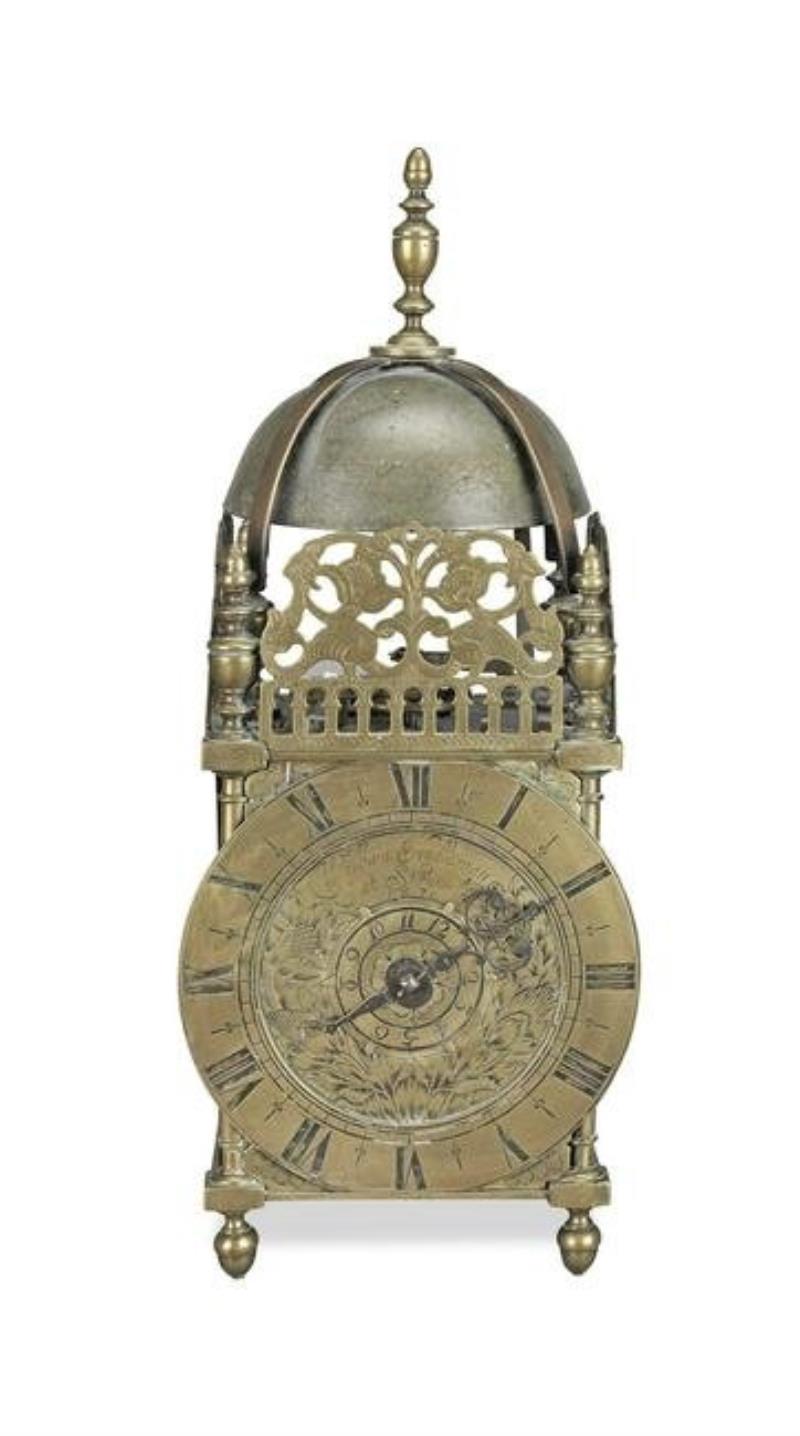
A rare late 17th century English dated lantern clock with verge escapement and alarm
William Holloway, Stroud. Dated 1676
Surmounted by five finials with distinctive acorn knops (bell strap replaced) over tall arcaded frets, brass rear panel and side doors, the tapering Doric columns terminating in acorn feet, the Roman chapter ring with tall fleur de lys half-hour markers, inner quarter hour track and single blued steel pierced hand, the centre signed in three curved lines between XI and I, 'William Holloway/ at Stroud/ 1676' over a wreath of flowerheads and foliage, with Arabic alarm-setting disc engraved with a rose, the weight driven movement with knife-edge verge escapement, the top potance and front verge arbor with decorative detail, the short pendulum with rounded bob, striking on the bell above, the hammer stop with filed and chamfered edges. 41cms (16ins) high.